Want to know how tin ore dressing equipment operates efficiently? This article deeply analyzes the tin ore dressing process, covering core technologies such as gravity separation, flotation, and magnetic separation, as well as equipment selection, providing you with a professional overall solution for tin ore dressing to help improve the recovery rate of concentrate.
Tin (Sn) as an extremely important strategic metal plays an irreplaceable role in electronic welding, alloy manufacturing, and military industries. However, due to its high density, complex particle size distribution, and diverse associated minerals, the beneficiation of tin ore is extremely difficult. According to industry data, more than 68% of mining sites report that traditional equipment is not well adapted to high silted slurry, with an average comprehensive recovery rate loss of over 15%.
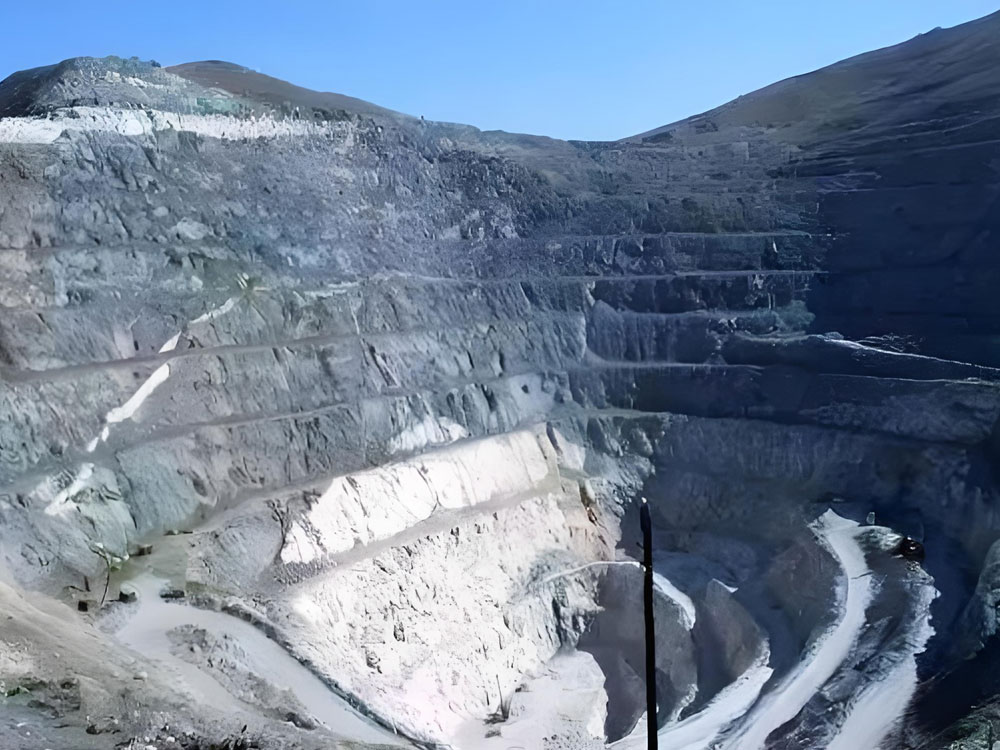
(Gejiu Tin Mine in Yunnan, China)
For mining investors and beneficiation engineers, the key to efficiently extracting tin from complex ore lies in selecting appropriate tin ore beneficiation equipment and formulating scientific beneficiation processes. This article will deeply analyze the core processes, key equipment, and solutions to common problems in tin ore beneficiation.
一. the Core Technological Process of Tin Ore Beneficiation
The beneficiation of tin ore usually follows the principle of "more crushing, less grinding, and early collection". A complete tin ore beneficiation process typically includes: raw ore crushing and washing, grinding and classification, separation operations (gravity separation, flotation, magnetic separation), and concentrate dewatering.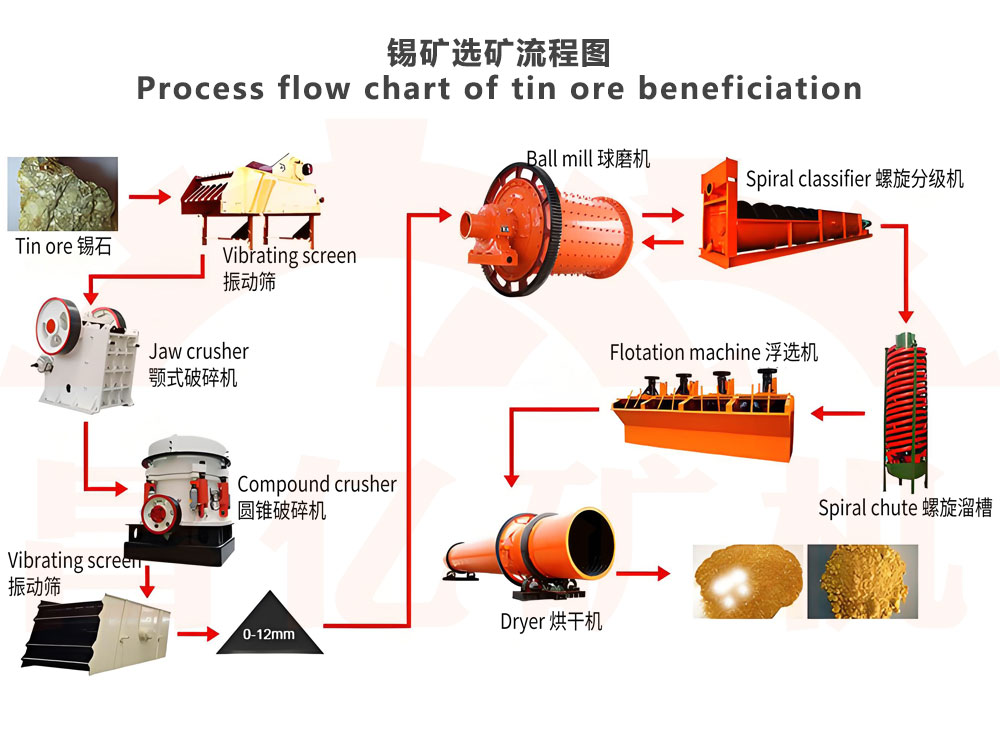
1. Crushing and Grinding Classification: The Foundation of Monomer Liberation
Before the raw ore enters the sorting process, it must be crushed and ground to achieve monomer liberation of cassiterite from gangue minerals.
Crushing stage: The combination of "Jaw Crusher (coarse crushing) + Cone Crusher (medium and fine crushing)" is usually used to crush the large raw ore to about 10-25mm. For sand tin ore with high mud content, a washing machine is also needed for desliming.
Grinding and classification: This is the key to determining the recovery rate. Due to the brittleness of cassiterite, over-grinding easily produces difficult-to-recover ore slime. Therefore, rod mills or grid-type ball mills are often used in conjunction with spiral classifiers or hydrocyclones, with strict control over the fineness of grinding to avoid the phenomenon of "over-fine crushing."
2. Gravity Separation Process: The "Main Force" in Tin Ore Beneficiation
Using the significant density difference between cassiterite and gangue for separation is the most economical and environmentally friendly method in tin ore beneficiation. Gravity separation is mainly suitable for tin ores with coarse and medium grain distribution.
Crushing Stage: For ore with particle sizes of 0.04~10mm, the jig machine is the preferred equipment. It has a large processing capacity and can effectively discard a large amount of tailings.
Refining Stage: For fine cassiterite with particle sizes of 0.02~2mm, the shaking table, with its extremely high separation accuracy, can produce high-grade tin concentrate.
Pre-concentration and Cleaning: The spiral chute has a simple structure and does not require power, and is often used for the pre-concentration of coarse cassiterite or the recovery of tailings.
3. Flotation and Magnetic Separation Processes: The "Aid" for Complex Ores
Flotation Method: When the grain size of cassiterite is extremely fine (<19μm) or the ore properties are complex, the recovery rate of gravity separation will significantly decrease. At this point, it is necessary to adopt the flotation process, using collectors such as styrene phosphonic acid, alkyl hydroxamic acid, etc., to recover the fine-grained cassiterite in the flotation machine.
Magnetic Separation Method: Tin ores often occur with magnetite, hematite, and other iron minerals. To improve the grade of tin concentrate, wet high-intensity magnetic separators or dry magnetic separators are commonly used to remove magnetic impurities before or after gravity separation or flotation.
二. Mineral Processing Solutions for Different Types of Ore
The properties of different ores determine the configuration differences of tin ore beneficiation equipment. The following are three typical ore beneficiation solutions.
1. Multi-metal sulfide tin ore beneficiation solution
This type of ore is often associated with copper, zinc, sulfur, and other sulfide minerals.
Process strategy: Prioritize flotation desulfurization, followed by gravity separation to recover tin.
Process: First, use a flotation machine to float out copper, zinc, sulfur, and other sulfide minerals to avoid interference with the subsequent gravity separation of cassiterite; the flotation tailings then enter a shaking table or spiral chute to recover cassiterite.
2. Iron-tin ore (skarn type) beneficiation solution
The ore contains a large amount of magnetic iron minerals, which seriously interferes with the separation.
Process strategy: magnetic separation to remove iron, gravity separation to extract tin.
Process: First, use a weak magnetic separator to separate magnetite. If there are hematite and other weakly magnetic minerals, a strong magnetic separator can be used in conjunction; the magnetic separation tailings finally enter the gravity separation equipment (such as centrifugal separator, shaker) to extract tin concentrate.
3. Fine-grained and tin-bearing tailings beneficiation solutions
Addressing the issue of micro-fine-grained cassiterite loss during the grinding process.
Process strategy: Desliming-floatation combined, or centrifugal enhanced gravity separation.
Process: First, use a hydrocyclone to remove interfering sludge, and then use an efficient flotation column or flotation machine for the recovery of micro-fine particles; or use a centrifugal beneficiation machine to strengthen and enrich the fine mud.
三. FAQ
In actual production, mining plants often face issues such as low recovery rates and substandard concentrate grade. Below are answers to common questions.
Q1: Why has the recovery rate of my tin ore beneficiation not increased?
The most common reasons are "overgrinding" and "fine particle loss." Tin ore is brittle, and excessive grinding time will produce a large amount of fine-grained ore sludge, which is difficult for traditional gravity separation equipment to capture. It is recommended to optimize the grinding and classification process, adopt "staged grinding and staged separation," and introduce centrifugal separation machines or flotation technology to specifically recover fine-grained tin.
Q2: In the beneficiation of tin ore equipment, how should the jig and shaker be matched?
Generally, follow the principle of "from coarse to fine." The jig has a large processing capacity, suitable for treating coarse-grained ore (0.04-10mm) as a roughing equipment to pre-discharge tailings; the shaker has high separation accuracy but a small processing capacity, suitable for treating fine-grained ore (0.02-2mm) as a concentration equipment to improve the grade of concentrate.
Q3: Does the presence of a large amount of iron ore in the ore affect the grade of tin concentrate?
Yes. The density of iron minerals is close to that of cassiterite, and some have magnetic properties, making them easy to mix into the concentrate. Magnetic separation (weak magnetic separation or strong magnetic separation) must be added to the process to remove iron impurities before or after gravity separation, in order to ensure the purity of the final tin concentrate.
Q4: How to choose a reliable tin ore beneficiation equipment manufacturer?
It is recommended to conduct detailed ore beneficiation tests before selecting equipment. Configure the equipment according to the process flow determined by the test report to avoid blind purchasing. At the same time, it is crucial to investigate the manufacturer's past cases and after-sales service capabilities.
四. Conclusion
An efficient tin ore beneficiation process cannot be achieved without the collaborative operation of scientific design and high-quality tin ore beneficiation equipment. Whether it is the simple sand tin ore washing or the complex multi-metal vein tin ore sorting, only by adhering to the concept of "early collection and comprehensive recovery" can the economic value of the mine be maximized.
If you are facing technical bottlenecks in tin ore beneficiation, it is advisable to start by optimizing the existing process links and seeking new points of benefit growth.
Finally, for equipment selection advice or process optimization solutions, please contact the Changyi Mining Machine technical team.
